
What Is The Real World?
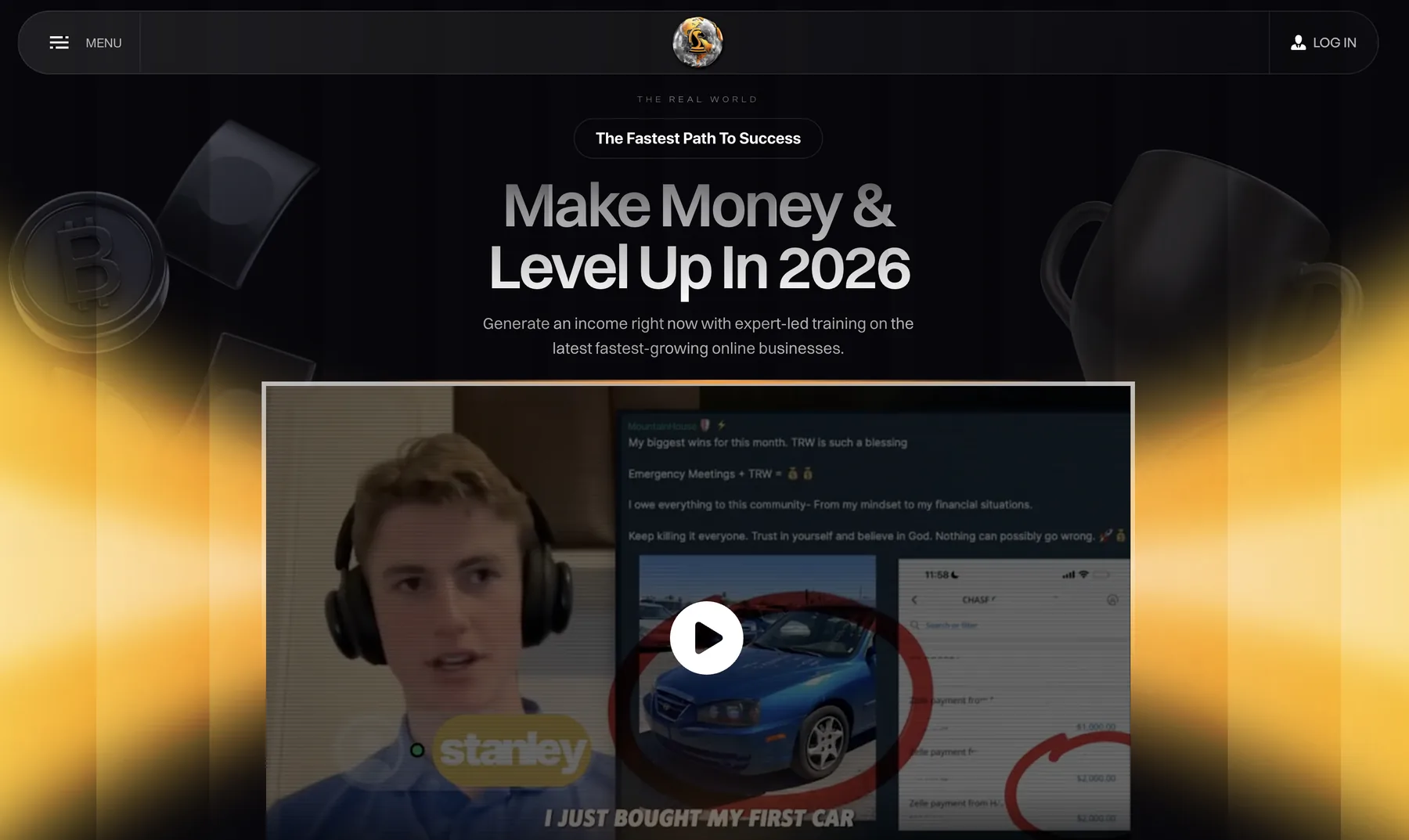
The Real World is Andrew Tate's online education and community platform for making money online.
It started in 2021 as Hustlers University, then took its current name in late 2022 after social platforms banned it and payment processors dropped it.
Today it costs $99 a month, teaches making money across "campuses" like e-commerce, copywriting, and crypto, and claims over 113,000 members.
Fans swear by it, critics call it overrated, and this page lays out both sides.
On this page
Quick facts
- What it is: Online education and community platform for making money online
- Formerly: Hustlers University (rebranded late 2022)
- Founded by: Andrew Tate, with Tristan Tate and a team of coaches
- Price: $99 a month (about $996 a year)
- Format: 100+ video courses, daily live coaching, community chat
- Campuses: e-commerce, copywriting, crypto, stocks, freelancing, content and AI, business
- Members: platform claims 113,000+
- Access: web portal and app, login at app.jointherealworld.com (not on the app stores)
- Refunds: none, cancel anytime
From Hustlers University to The Real World
The platform did not start under its current name. Andrew Tate launched it in 2021 as Hustlers University, a paid online course that promised to teach people how to make money online. To pull in students, he leaned on an affiliate model, which simply means members earned a commission every time they signed up someone new.
That commission turned ordinary subscribers into a sales force. Thousands of them cut Tate clips and posted them everywhere, so TikTok and YouTube filled with the same viral snippets, and the membership numbers climbed fast. The growth, though, came with a catch.
The viral promotion that built the platform also got it shut down. Mainstream social networks removed it for breaking their rules, and payment processors stopped handling its money, which cut off both its reach and its income. So in late 2022 the Tates rebuilt the program on their own software and renamed it The Real World, a move that let them control access and payments themselves rather than depend on companies that could pull the plug.
In this program what you buy is a subscription to a group, not a one-time course. Instead of paying once for a fixed set of lessons, you pay every month for ongoing access to the courses, daily live coaching, and a private community, and the pitch is that this rolling membership teaches you to make money better than a university degree would.
What's inside The Real World?
The Real World is organized into separate tracks the platform calls "campuses," and each campus teaches one specific way to make money rather than mixing everything together. The e-commerce campus, for example, walks you step by step from picking a product to setting up a store and running paid ads, so a beginner can follow a single path instead of guessing what to learn next. Every other money-making method gets its own campus built the same way.
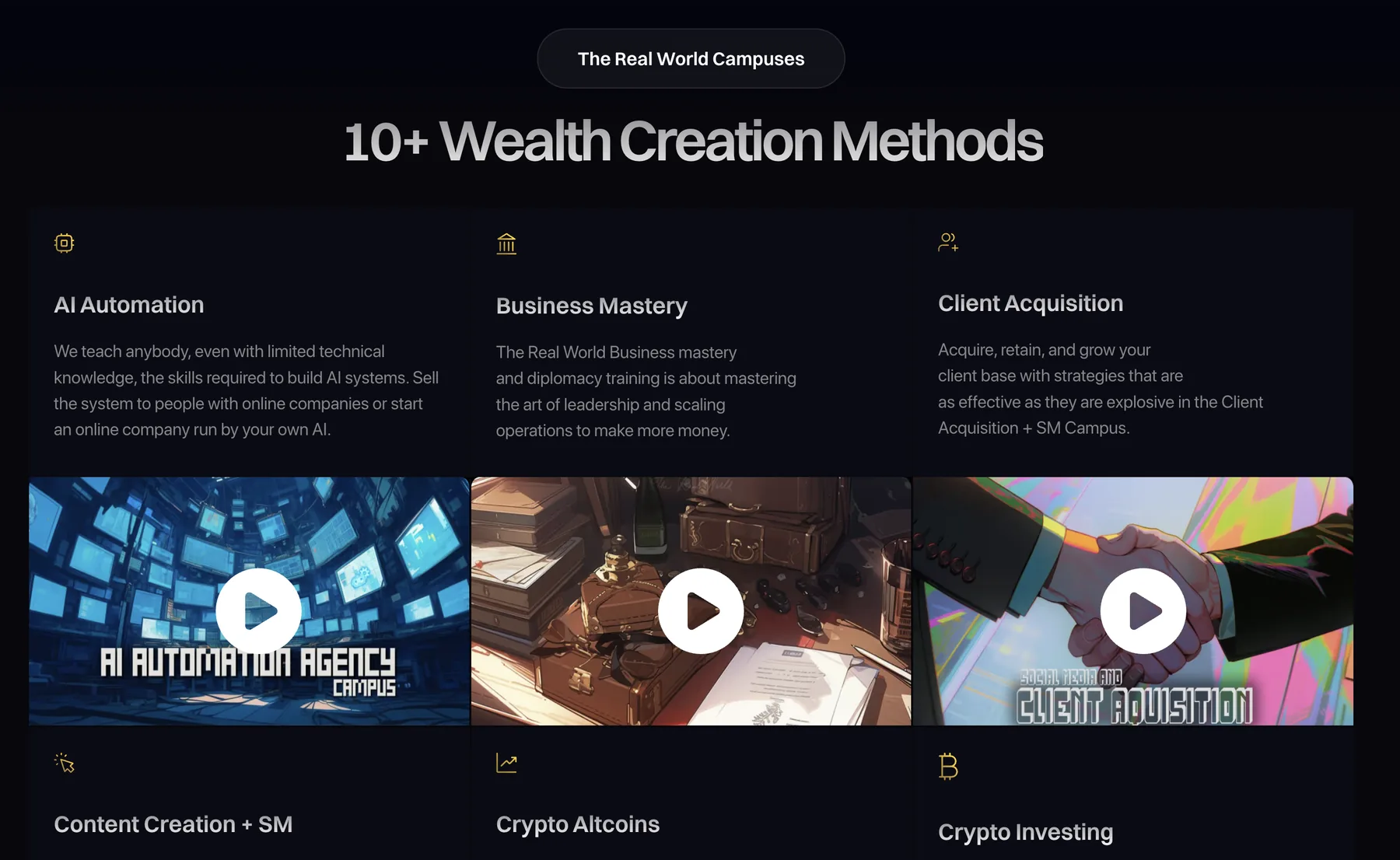
Those 10-plus campuses hold more than 100 video courses between them, which the platform markets as 19 wealth-creation methods. The topics cover the main ways people earn online today, and the lineup reads like a directory of modern side hustles:
- E-commerce and dropshipping, building online stores
- Copywriting, writing sales pages and marketing emails for clients
- Crypto and stock market investing
- Freelancing, selling a skill directly to clients
- Content creation and AI, growing an audience and using AI tools
- Business and finance, the fundamentals underneath the rest
Because markets shift fast, the recorded courses are backed by daily live sessions where coaches the platform calls "millionaire coaches" walk through current strategies and answer questions in real time. That setup is meant to keep the material current instead of letting it sit as a fixed library that ages. Tying it all together is a members' chat community where people share wins, ask for help, and hold each other accountable, which matters because most people quit a self-paced course alone but are more likely to keep going when others are working alongside them.
How much does The Real World cost?
| Plan | Price |
|---|---|
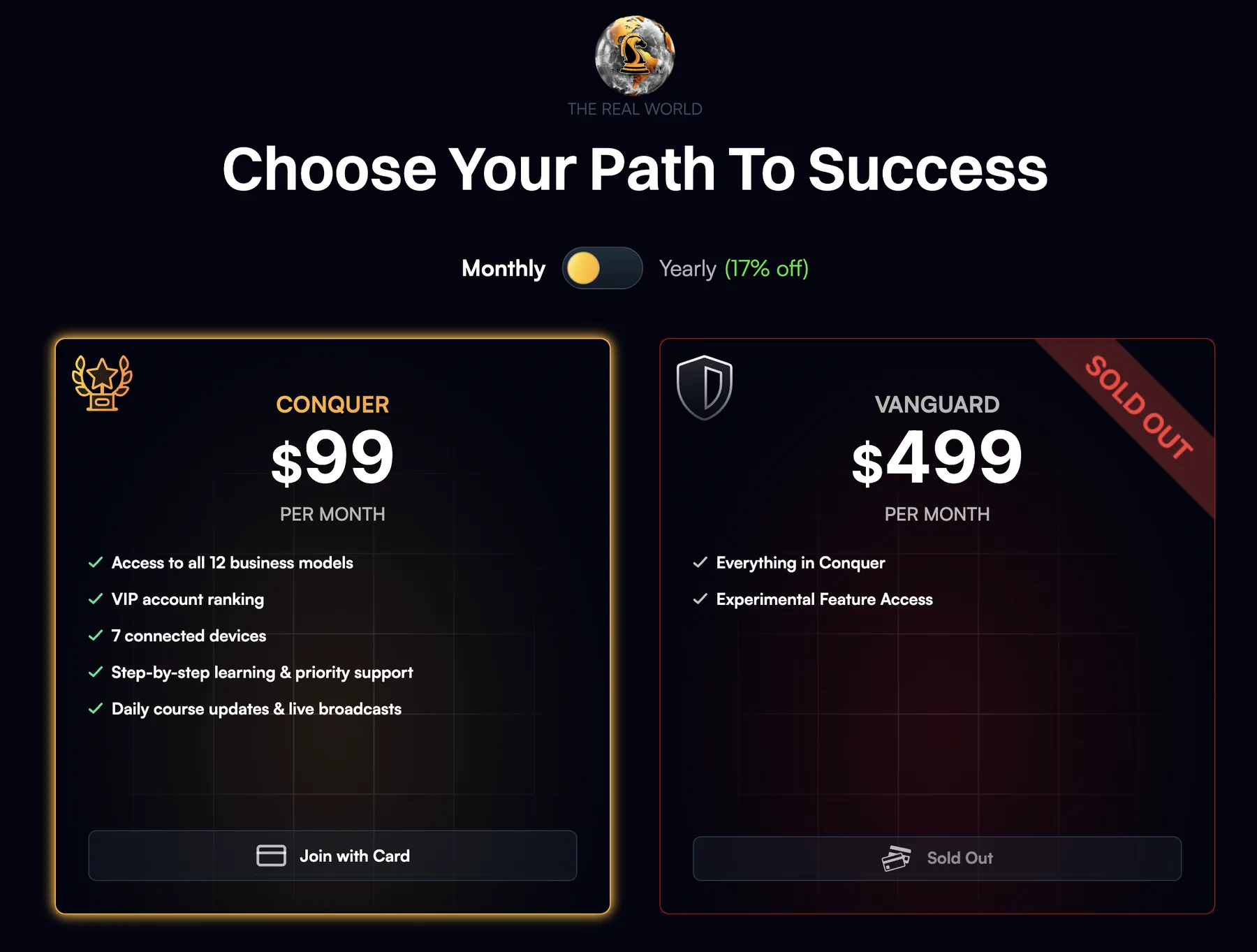
| Monthly | $99 per month |
| Annual | about $996 per year |
The $99 monthly plan unlocks the whole platform, with no add-ons or paid upgrades on top, and the annual plan works out a little cheaper, about one month free across the year. The official join page frames the $99 as a "locked-in" rate and warns it will rise to $147 a month, but that urgency is a standard sales tactic, so treat the countdown as marketing rather than a hard deadline. For context, the same program charged $49.99 a month back when it was Hustlers University, so the headline price has roughly doubled since the early days.
But before you enter your card details, there are 2 things you must know:
- There are no refunds. Once you pay for a month, that month is spent, whether you use the platform or not.
- You can cancel anytime to stop the next charge, which means the real risk is capped at one month of access if you decide it is not for you.
Logging in and the app
The Real World runs on its own software, which is why you do not sign in through a mainstream service the way you would with most apps. Because the platform was rebuilt in-house, you log in at its own members' area at app.jointherealworld.com, using the email and password you set when you subscribed.
What you reach there is a self-contained app, not a single web page. It comes in two forms, a web app you open in any browser and a mobile version for your phone, so you can start a course at your desk and pick it up later from your phone.
There is one catch worth knowing up front. The app is not on the Apple App Store or Google Play, so searching "The Real World" on your phone will not find it.
That gap is also where scammers move in. Any app on those stores claiming to be The Real World is fake, because the real version lives only on the platform's own site, the same address you log in at.
That absence is deliberate, and it ties back to the bigger picture. App stores can pull an app at will, the same way social networks and payment processors cut the business off in 2022. By staying off the stores, The Real World keeps the one lever it controls, which is how it has stayed online since.
Is The Real World worth it?
The honest answer is that it depends on the person, not the product, and the case sits on both sides of that line. Supporters value it because it hands a beginner a structured path instead of a pile of guesses. One campus that walks you from start to finish is worth something next to a thousand free YouTube videos that never tell you which to watch first, and the daily live coaching keeps that material current in a way a static one-off course cannot.
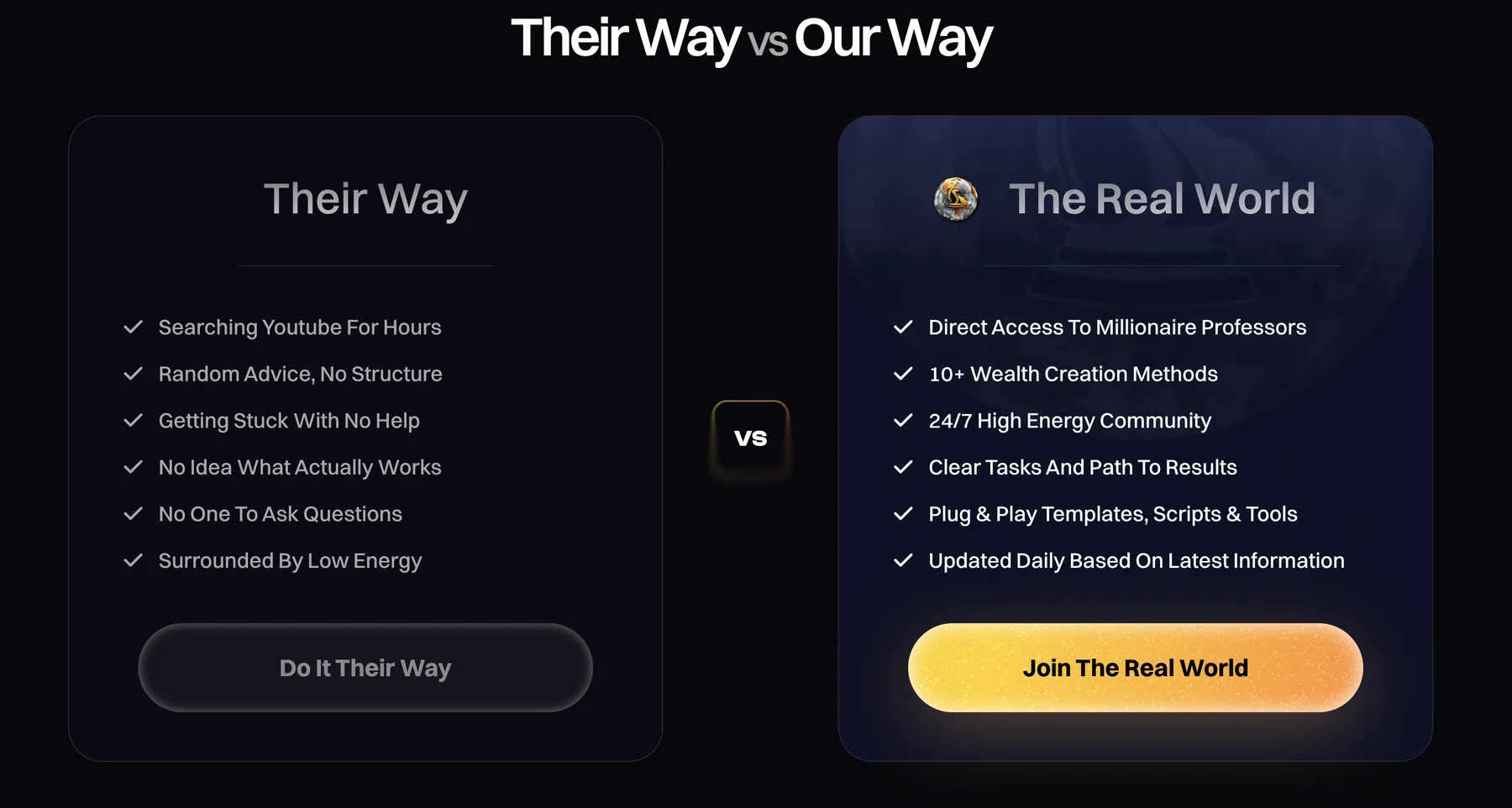
The community adds what most solo learners are missing, which is accountability, so people are likelier to finish instead of quitting alone. At $99 a month, that bundle also undercuts most paid mentorships and cohort courses.
The criticism is just as real. Reviewers often call it overrated, because most of the raw information is available free on YouTube and blogs, so you are partly paying for packaging and community rather than secret knowledge.
That critique sharpens once you remember the affiliate model from earlier. Members earned commissions for recruiting others, so a lot of the glowing promotion came from people with a financial reason to sell it, which blurs how much of the hype to trust.
Results also vary enormously and track the work each member puts in. Most people do not get rich, so it is best treated as paid content and a community, not a guaranteed income.
None of this is financial advice, and the decision comes down to one question. If you will actually show up for the structure, the live coaching, and the community, $99 a month is reasonable for what you get. If you will not, it is $99 a month for videos you could have found free.
Andrew Tate and The Real World
Andrew Tate is the founder and the public face of The Real World, and that single fact explains how the platform grew so fast. It runs on his name and his audience, so the marketing engine was built in before the first course went live. When you join, you are buying into his brand as much as the lessons inside.
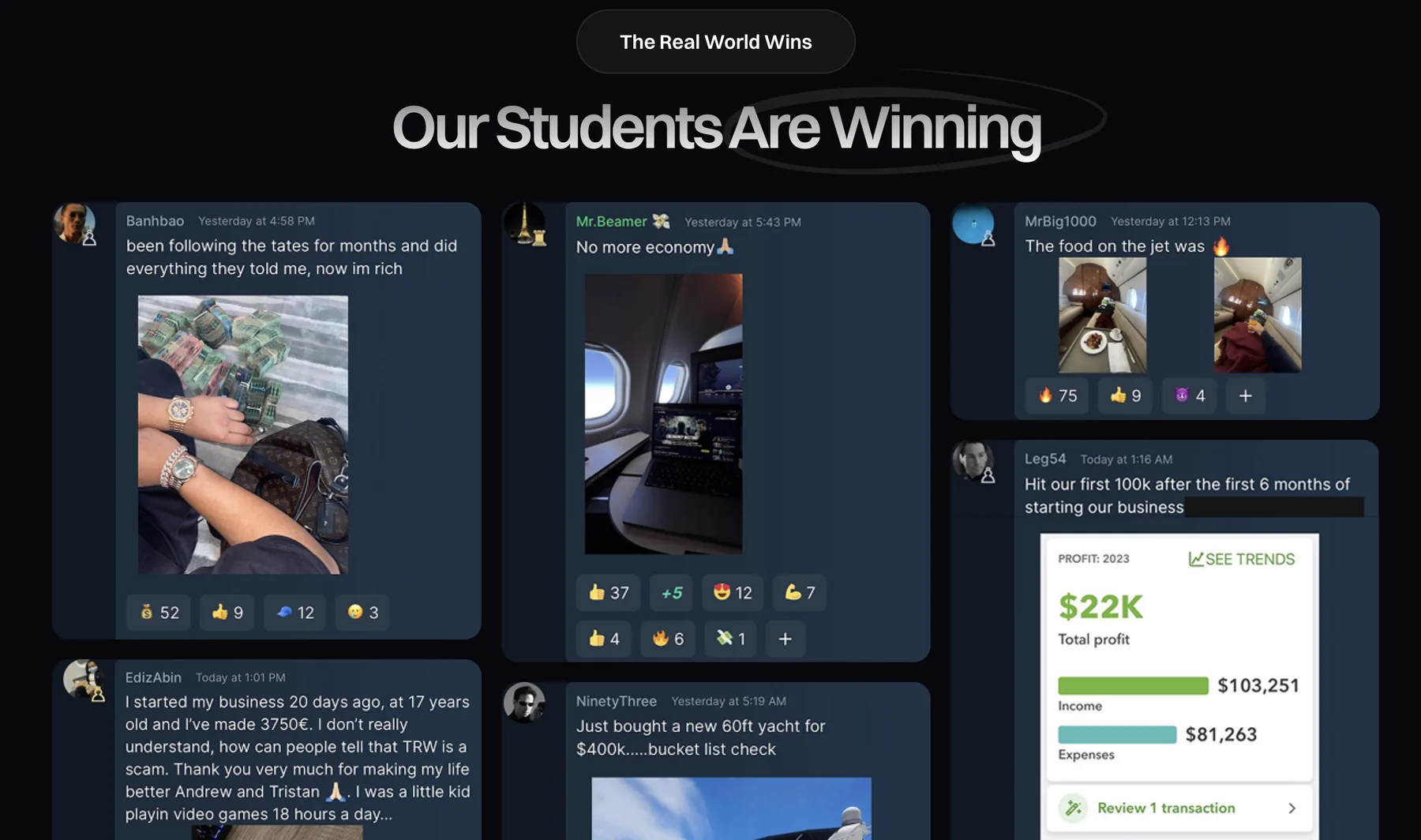
Andrew is the figurehead more than the daily instructor, though, because the actual teaching is spread across other people. His brother Tristan Tate promotes the platform alongside him, while a team of coaches handles the day-to-day instruction inside the campuses. So the voice that sells you the membership is rarely the voice walking you through the material. The Real World is also only the entry tier of that brand, because above it sits the War Room, the brothers' private, invitation-only network that costs thousands a year rather than $99 a month.
That tie to the Tate brand cuts both ways. The same name that drives the sign-ups also drags along everything attached to it, and right now that includes a serious legal cloud. Both brothers are facing an ongoing criminal case in Romania, with allegations that include human trafficking, which they deny and have not been convicted of.
FAQ
Is The Real World a scam?
No, not in the legal sense. The Real World is a real, paid product that delivers the courses and community it advertises. Whether it is worth the monthly price is debated, and there are no refunds once you are charged, so read the terms before you join.
How do you cancel The Real World subscription?
You cancel through your account on the platform, which stops the next charge. You keep access until the end of the period you have already paid for. There is no automatic refund for the time left, so the cleaner move is to cancel before your renewal date.
What happens when your subscription ends?
You lose access. Once your paid period runs out, the courses, the live sessions, and the community all close to you until you subscribe again. There is no free tier to fall back on.
Is The Real World still running in 2026?
Yes. As of 2026 The Real World is still operating and taking new members. It runs as a paid monthly subscription, the same model it has used since the Hustlers University relaunch, with Andrew Tate as its public face.